
If you’ve ever read a Forbes article and noticed the small “BrandVoice — Paid Program” tag at the top, you’ve seen BrandVoice in action.
It’s Forbes’s native advertising platform — and it’s their biggest revenue engine. Brands like FedEx, Deloitte, and SAP have used it to publish thought leadership content on Forbes.com under their own name, with their own narrative, on their own schedule.
It’s also expensive. Entry-level campaigns start at $50,000. Serious programs run well into six figures.
So the question isn’t whether BrandVoice exists or what it does. The question is whether it makes sense for your brand, at your stage, with your budget. Here’s an honest assessment.
How BrandVoice Works
The mechanics are straightforward. You (or your agency) create the content. Forbes provides the platform, editorial support, and distribution.
Your brand gets a dedicated content hub on Forbes.com — formatted as forbes.com/sites/yourbrandname/ — where you can publish articles, videos, and other multimedia content. It sits within the same content management system and benefits from the same SEO infrastructure as Forbes editorial content.
Every piece is clearly labeled “BrandVoice — Paid Program” at the top. Forbes doesn’t try to hide that this is sponsored content. That transparency is actually one of BrandVoice’s stronger qualities — it’s a cleaner model than some native advertising programs that blur the lines more aggressively.
The content is yours to shape. Forbes provides editorial guidance and quality standards, but you control the messaging, the topics, and the narrative. That’s the fundamental trade-off: you get control in exchange for the “paid” label.
What It Costs
Forbes structures BrandVoice in tiered packages. Based on publicly available data and industry reporting, here’s the pricing landscape:
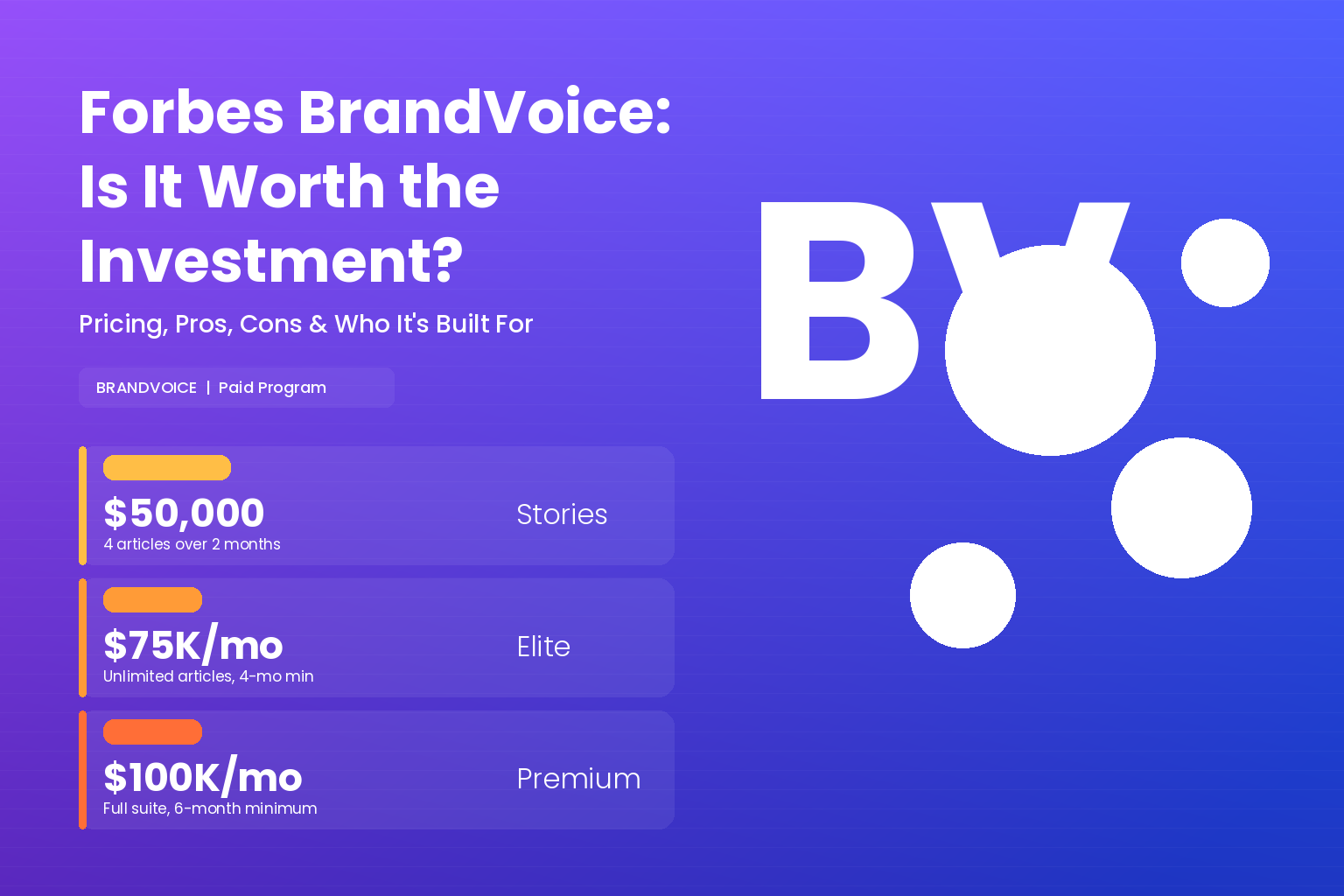
BrandVoice Stories is the entry point. $50,000 buys you 4 articles over a 2-month period. That works out to roughly $12,500 per article — which sounds steep until you consider the platform and the audience.
BrandVoice Elite is the mid-tier. $75,000 per month with a 4-month minimum commitment, totaling $300,000. This tier removes content volume restrictions, so you can publish as many articles as you want during the contract period.
BrandVoice Premium is the top tier. $100,000 per month with a 6-month minimum commitment — $600,000 or more. Beyond unlimited content, Premium clients get enhanced distribution, influencer outreach, and priority placement.
Special multimedia campaigns — Forbes calls them Pulse — start around $300,000 for a single month and include video, interactive content, and cross-platform distribution.
Print placements in the physical Forbes magazine are priced separately and typically run into six figures for premium positions.
Regional Forbes editions (Forbes Australia, Forbes Asia, Forbes Colombia, etc.) have their own rate cards and are generally less expensive than the main U.S. site.
The Case for BrandVoice
When it works, BrandVoice works well. Here’s why some brands invest:
Full narrative control. Unlike earned media, where a journalist decides the angle and what to include, BrandVoice lets you tell your story exactly the way you want to. For product launches, executive positioning, or complex narratives that don’t compress well into a journalist’s article, this matters.
Permanent digital footprint. BrandVoice articles stay indexed on Forbes.com indefinitely. They continue generating organic search traffic and backlink value long after the campaign ends. Forbes’s domain authority (94 out of 100) means your sponsored content can rank surprisingly well in Google search results.
Measurable distribution. Forbes provides analytics on your BrandVoice content — views, engagement, shares. For marketing teams that need to report ROI on every dollar, this level of measurement is valuable compared to the less predictable outcomes of earned media.
Association with the Forbes brand. Even with the “Paid Program” label, publishing on Forbes.com carries weight. Your content lives alongside reporting from one of the most recognized business publications on the planet. For enterprise sales cycles where brand perception influences buying decisions, that association can move the needle.
The Case Against BrandVoice
Now the other side.
The label is the label. “BrandVoice — Paid Program” is visible at the top of every article. Informed readers — including the investors, executives, and partners you most want to impress — know exactly what it means. It’s advertising. Well-produced, well-distributed advertising, but advertising.
The cost puts it out of reach for most businesses. $50,000 is the floor. If you’re a startup, a growing agency, or a mid-size company, that’s a significant chunk of your marketing budget for 4 articles. The question isn’t just “can we afford it?” but “is this the best use of $50K?”
It doesn’t replace earned credibility. A journalist independently choosing to write about your company signals something fundamentally different than your company paying to publish on a prestigious platform. Both have value, but they serve different functions. BrandVoice builds awareness and controlled visibility. Earned coverage builds trust.
SEO treatment may differ. While BrandVoice content benefits from Forbes’s domain authority, there’s ongoing debate among SEO professionals about whether Google treats sponsored content links the same way it treats editorial links. Forbes is transparent about the paid nature of BrandVoice, and Google’s algorithms are increasingly sophisticated at distinguishing between editorial and commercial content.
BrandVoice vs. Earned Coverage: When to Choose Which
This isn’t an either/or decision for every brand, but if you’re choosing where to put your budget first, here’s a framework:
Choose earned editorial coverage if you’re building credibility from the ground up, you want the strongest possible trust signal, or your budget is under $50K. Earned coverage costs nothing in placement fees — you invest in story development, pitching, and relationships (either your own time or a PR agency’s). The payoff is coverage that carries no labels and maximum authority.
Choose BrandVoice if you need guaranteed placement on a fixed timeline, you want complete control over the narrative, and you have an enterprise-level marketing budget that can absorb $50K+ as one component of a broader campaign.
Choose both if you’re a mid-to-large brand that wants earned coverage for credibility and BrandVoice for controlled storytelling. This is actually a common strategy among sophisticated marketers — the earned feature validates the brand, and the BrandVoice content expands the narrative on their terms.
For most businesses asking “how do I get into Forbes?” — earned coverage is the better starting point. It’s more credible, more cost-effective, and it compounds over time as your media presence grows.
We walk through that entire process in our guide on how to get featured in Forbes.
The Bottom Line
Forbes BrandVoice is a powerful platform for the right brand at the right stage. It offers something earned media can’t: guaranteed placement, full narrative control, and measurable distribution on one of the world’s most trafficked business websites.
But it’s not a shortcut to credibility. The “Paid Program” label exists for a reason, and your most discerning audiences will notice it. For the vast majority of founders, executives, and growing companies, earned editorial coverage delivers more credibility per dollar spent — and it’s where we’d recommend starting.
Looking for Forbes coverage that starts with your story, not your budget? See how we help clients earn authentic editorial features.
For the full pricing landscape across all Forbes options, see our breakdown of how much a Forbes feature actually costs. And if you’re evaluating the membership route, here’s our Forbes Councils review.