

You got the email. Something along the lines of: “Congratulations — you’ve been selected for the Forbes Business Council.”
It feels exclusive. It sounds prestigious. And if you’re anything like most founders and executives who forward these emails to their teams, your first reaction is probably a mix of excitement and suspicion.
Both reactions are warranted.
Forbes Councils is a legitimate membership product with real benefits. It’s also frequently misunderstood, sometimes oversold, and not the right fit for everyone. Here’s the honest breakdown from a PR agency that’s studied every route into Forbes.
What Forbes Councils Actually Is
Forbes Councils is a collection of industry-specific membership communities — Business Council, Technology Council, Agency Council, Finance Council, Coaches Council, and several others.
They’re managed by The Community Company under a licensing agreement with Forbes Media. This is an important distinction: Forbes Councils is not the same entity as Forbes editorial. The journalists writing investigative pieces and trend stories for Forbes operate separately from the Councils program.
Each council has eligibility requirements. For the Business Council, you typically need to be a senior executive, founder, or owner of a company generating at least $500,000 in annual revenue or financing. The Technology Council has a $1,000,000 threshold.
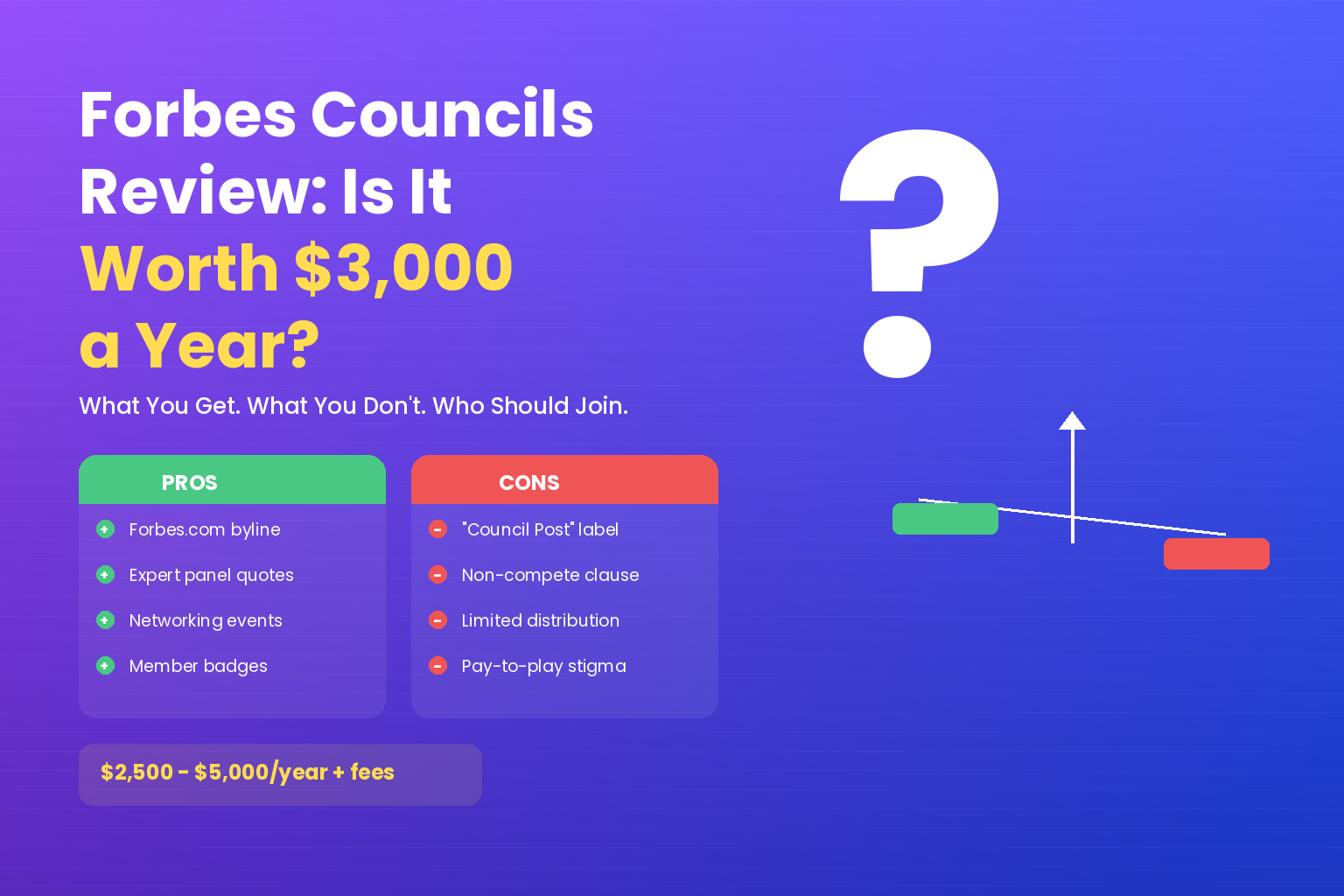
The cost: $2,500 to $5,000 per year depending on the council, plus a one-time initiation fee of $500 to $600. Premium memberships (which include having articles written for you) run around $6,400 to $6,800 per year.
What You Actually Get
Let’s go benefit by benefit.
Publishing on Forbes.com. This is the headline perk. As a member, you can submit bylined articles to Forbes.com. Your articles go through an editorial review process and, if approved, appear on the site with your photo, bio, and a link to your website.
The fine print: articles are labeled “Council Post” with a disclosure that it’s a fee-based membership program. You’re limited to roughly one article per month. And submission doesn’t guarantee publication — the editors can (and do) reject pieces that don’t meet their standards.
Expert Panels. These are roundup-style articles where Forbes poses a question and publishes short answers from 10 to 15 council members. They require minimal effort — you write a 2-3 sentence answer — and they’re a decent way to get your name and photo on Forbes.com regularly. For many members, this is actually the most practical benefit.
Networking. Virtual events, member-led groups, and the member portal app. The value here depends entirely on how active you are. Some members report meaningful connections. Others say they never logged in after the first month.
Badges and Social Proof. You get to use the “Forbes Council Member” badge on your website, email signature, and social media. For prospects who don’t look closely at what “Council” means, this carries weight.
Concierge Perks. Travel discounts, business service deals, insurance options. Honestly, most of these are comparable to what you’d find with a decent credit card or professional membership. They’re nice-to-haves, not buying reasons.
When It Makes Sense
Forbes Councils works well for a specific type of person:
You’re an executive who wants a regular publishing presence on a recognizable platform without the grind of pitching journalists individually. You understand that “Council Post” is different from earned editorial coverage, and you’re fine with that trade-off. You’ll actually write and submit articles consistently — because the members who get value from this are the ones who show up and publish, not the ones who pay the fee and forget about it.
It can also work as a supplement to an earned media strategy. Some of our clients use earned coverage for credibility and Council membership for publishing volume. The two aren’t mutually exclusive.
When It Doesn’t
Here’s where things get uncomfortable.
The “invitation-only” framing is misleading. Yes, there’s an application process. But the outreach is commercially driven. If your company meets the revenue threshold, you’ll likely receive an invitation. This isn’t Forbes’s editors recognizing your work — it’s a sales funnel.
Council content doesn’t get the same distribution. Articles by Council members are not promoted on Forbes’s main social media accounts, which have over 19 million followers. They appear on the much smaller Forbes Councils social channels. The reach difference is significant.
The non-compete issue. Multiple sources — including PR professionals and former Council members — have reported that joining a Council can prevent you from being sourced as an expert in regular Forbes editorial articles. At least one incident has been documented where a Forbes contributor was blocked from writing about a subject because that person was a Council member. If your goal is earned editorial coverage in Forbes, a Council membership might actually work against you.
The credibility gap is widening. Five years ago, most readers didn’t know the difference between a Council Post and a regular Forbes article. That’s changing. Investors, sophisticated buyers, and anyone who spends time reading Forbes regularly can spot the difference. The “Council Post” label, the disclosure about fee-based membership — these are signals, and more people are reading them.
You’re capped on output. One article per month, with an editorial review process that can take weeks. For $3,000+ per year, that’s a limited publishing cadence compared to what you could achieve on LinkedIn, Medium, or your own blog — all of which are free.
Councils vs. Earned Editorial Coverage
This is the comparison that matters most for people reading this post.
An earned editorial feature means a Forbes journalist or contributor chose to cover you because your story, expertise, or data was genuinely interesting to their readers. There’s no label. No disclosure. No asterisk. It’s the kind of Forbes mention you put in an investor deck or media kit without any caveats.
A Council Post means you paid for membership and wrote an article that was approved by the editorial team. It sits on Forbes.com, which is valuable for SEO and general visibility. But it carries a clear signal that this was a paid pathway, not editorial recognition.
For brand credibility with sophisticated audiences — investors, enterprise buyers, strategic partners — earned coverage carries substantially more weight.
For thought leadership volume and a regular Forbes presence — Councils can fill a role, especially when paired with earned media efforts.
They serve different purposes. The mistake people make is treating them as interchangeable.
The Bottom Line
Forbes Councils isn’t a scam. It’s a membership product with real but limited benefits, and it works best for people who understand exactly what they’re getting.
If you want maximum credibility and the kind of Forbes feature that genuinely shifts how people perceive your brand — earned editorial coverage is where the ROI lives. It’s harder to get. It takes longer. But when it lands, it means something that a Council Post simply can’t replicate.
If you want a supplemental publishing channel on a recognizable platform and you’ll actually use it — Councils can be a reasonable addition to a broader PR strategy.
Just don’t mistake the invitation email for a recognition of your achievements. It’s a sales pitch. A well-crafted one, but a sales pitch all the same.
Want Forbes coverage that doesn’t come with a “Council Post” label? See how we help clients earn authentic features.
For the full breakdown of every path into Forbes — costs, credibility, and trade-offs — read our complete guide on how to get featured in Forbes or our breakdown of how much a Forbes feature actually costs.