
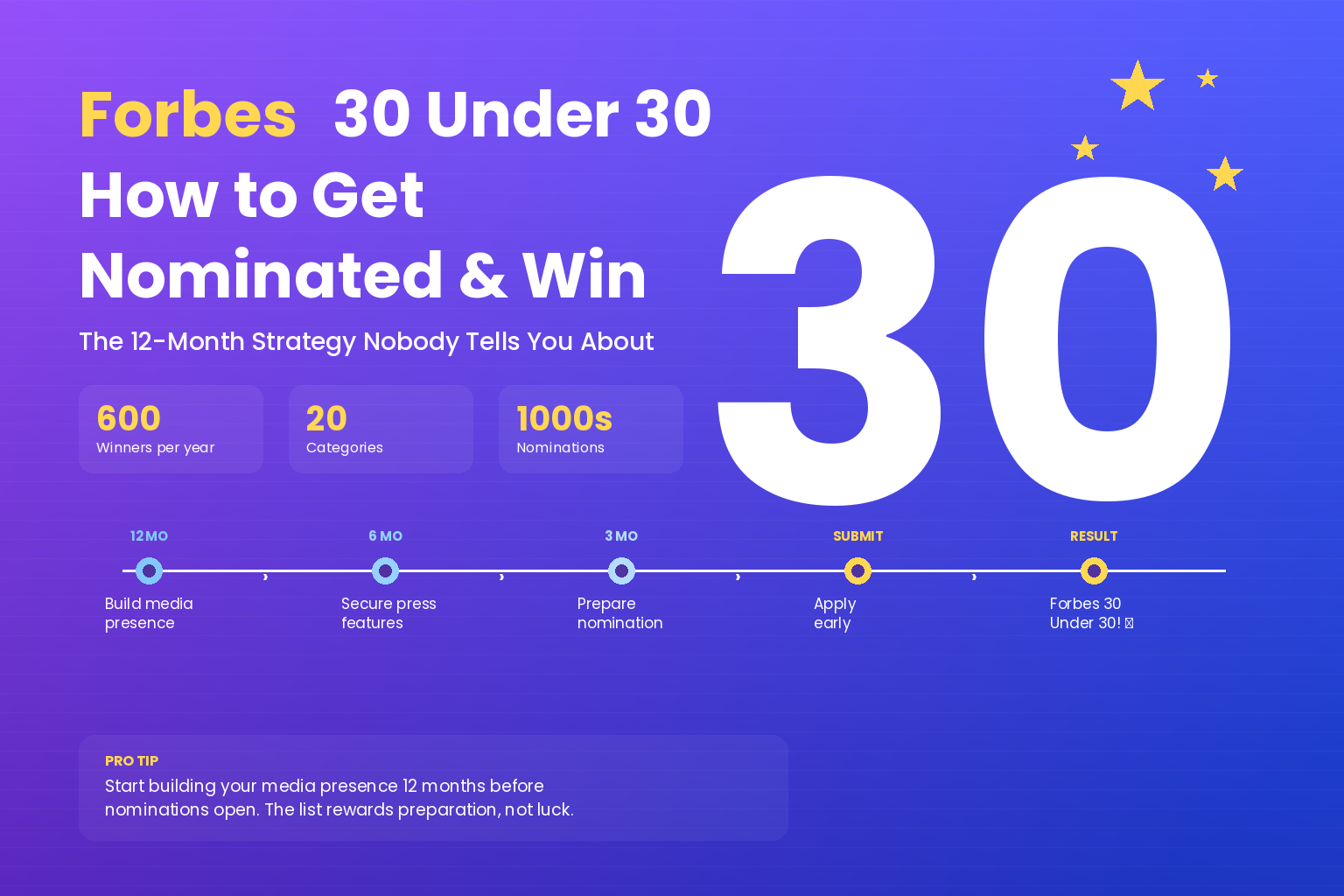
The Forbes 30 Under 30 list is one of the most recognized honors in business. Every year, it names 600 young founders, creators, scientists, and leaders across 20 categories — and every year, thousands of ambitious people wonder how the selection actually works.
Here’s what most people don’t realize: you can nominate yourself. The timeline matters far more than the application itself. And the single biggest thing you can do to improve your odds has nothing to do with the nomination form — it starts 6 to 12 months before nominations even open.
Let’s break the whole process down.

How the Forbes 30 Under 30 Process Actually Works
The process is more structured than most people assume, but also more accessible.
Nominations are open to everyone. You can nominate yourself, or someone else can nominate you — a colleague, mentor, investor, or friend. Both carry equal weight with the selection committee. There’s no disadvantage to self-nominating, despite what the modesty instinct might tell you.
There are 20 categories. Technology, Healthcare, Social Media, Retail & Ecommerce, Finance, Education, Science, Music, Art & Style, Food & Drink, Sports, Manufacturing & Industry, Social Impact, Enterprise Technology, Marketing & Advertising, Media, Games, Hollywood & Entertainment, Venture Capital, and Energy. Picking the right category matters — we’ll get to that.
Judges are industry-specific. Each category has its own panel of judges, typically comprised of venture capitalists, prior 30 Under 30 honorees, and recognized industry leaders. They review nominations against a rubric that weighs innovation, measurable impact, leadership, and trajectory.
Nomination windows open mid-year and close in the fall. The exact dates vary slightly from year to year, but the pattern is consistent. The Forbes 30 Under 30 list is typically published in late November or December.
You must be under 30 as of December 31 of the list year. If the list is for 2027, you need to be 29 or younger on December 31, 2027. This seems obvious, but the cutoff catches people who assume it’s tied to the nomination date.
What Makes a Winning Nomination
Judges see thousands of applications. The ones that rise to the top share a few common traits.
Measurable impact, not just impressive titles. “CEO of a startup” doesn’t tell judges much. “CEO of a startup that reached $1.5M ARR in 14 months with zero outside funding” tells them everything. Revenue growth, users served, funding raised, jobs created, communities impacted — give them numbers. Specificity is your friend.
Innovation or disruption, not just competence. The list isn’t looking for people who are very good at their jobs. It’s looking for people who are changing how something works. Are you building technology that didn’t exist before? Tackling a problem from an angle nobody else has tried? Challenging an assumption your entire industry takes for granted? That’s the signal judges are tuning into.
A narrative arc, not just a resume. The strongest nominations tell a story. Where you started, what obstacle you faced, what insight or moment changed your trajectory, and where you’re headed. Judges are human — they respond to compelling stories just like any reader. A nomination that reads like a LinkedIn bio won’t stick in anyone’s memory. A nomination that reads like the opening paragraph of a magazine profile will.
The right category. This is where people trip up. Don’t submit to Technology if your company is clearly a better fit for Healthcare or Retail & Ecommerce. Judges evaluate nominations within their category, not across the entire pool. A strong candidate in the wrong category competes against people who are a more obvious fit — and loses.
If your work genuinely spans multiple categories, choose the one where your impact is most measurable and where the competition is less obvious. A fintech company might do better in Finance than in Technology, depending on the year’s applicant pool.
Supporting materials that back up your claims. Recommendations from recognized figures in your space. Links to media coverage. Data from third-party sources. Awards. Speaking engagements. Anything that provides independent validation of the things you’re claiming about yourself.
Which brings us to the most important part of this entire guide.
The Strategy That Starts 12 Months Before Nominations Open
The founders who make the Forbes 30 Under 30 list didn’t start preparing the month nominations opened. They started building their case a year before.
Here’s the pattern: the nominees who win typically have existing media coverage, a visible LinkedIn presence, speaking appearances or podcast features, and a professional footprint that extends beyond their company’s website.
When a judge Googles a nominee’s name — and they will — the difference between finding a sparse LinkedIn profile and finding a trail of press coverage, industry commentary, and thought leadership is the difference between “maybe” and “yes.”
This means the single most valuable thing you can do for a 30 Under 30 nomination is build your media presence before the nomination window opens.
Get featured in 2 to 3 publications in the 6 to 12 months before you apply. Not necessarily Forbes itself — coverage in Entrepreneur, TechCrunch, Inc., industry-specific publications, or respected podcasts all count. Judges want to see that the broader market already recognizes your work. A nomination backed by existing coverage is dramatically stronger than one that arrives cold.
We walk through the complete process of earning editorial coverage — including Forbes — in our guide on how to get featured in Forbes.
Build your LinkedIn consistently. Publish insights about your industry. Share data from your company’s experience. Comment thoughtfully on relevant conversations. The goal isn’t to “go viral” — it’s to create a visible, credible body of work that judges can find.
Accept speaking invitations. Podcast appearances, industry panels, conference talks — these create digital footprints that signal credibility and reach. Even small stages matter. The point is having your name attached to substantive discussions, not just your company’s About page.
The Timeline: Month by Month
12 months out: Start your media outreach. Pitch publications, respond to journalist queries through platforms like HARO and Connectively, and begin building relationships with writers who cover your space.
6 months out: Secure 2 to 3 meaningful press features. Ramp up LinkedIn content. Start collecting data and proof points you’ll need for the nomination.
3 months out: Prepare your nomination materials. Write your narrative. Gather recommendation letters from mentors, investors, or industry leaders who can speak to your impact. Compile your metrics in a clean, compelling format.
When nominations open: Submit early in the window. Don’t wait until the deadline — early submissions may get more attention from judges who are fresh and not yet fatigued by the volume.
After submission: If you have professional connections to any of the judges — reach out through LinkedIn or mutual contacts. Don’t pitch them aggressively. A simple message noting that you’ve applied and respect their work is enough. The goal is to ensure they notice your nomination in the pile.
What About Forbes 40 Under 40?
The Forbes 40 Under 40 list operates differently from the 30 Under 30 and varies by Forbes regional edition. Some are nomination-based with an open application process. Others are editorially selected by Forbes journalists and don’t accept nominations at all.
The strategy, though, is fundamentally the same: build a media presence that makes you visible to the people making the selection, demonstrate measurable impact, and tell a story that resonates.
If you’re targeting a specific regional Forbes 40 Under 40 list, research that edition’s submission process individually — the requirements differ across Forbes U.S., Forbes Asia, Forbes Middle East, and other regional editions.
What Happens If You Don’t Make the List
Here’s the part nobody writes about.
Most nominees don’t make the list. The math is simple — thousands apply, 600 are selected. If your name isn’t on the list this year, that doesn’t mean the work was wasted.
Every press feature you secured, every LinkedIn post you published, every relationship you built with a journalist — all of that continues working for your brand long after the list is announced. The media presence you built for the nomination is an asset regardless of the outcome.
And you can reapply. Many 30 Under 30 honorees were nominated multiple times before they were selected. The judges change, the competitive landscape shifts, and a nomination that didn’t make the cut in one year might be the standout in the next — especially if you’ve continued growing your impact and visibility in the interim.
The founders who treat the 30 Under 30 as a byproduct of consistently building their profile — rather than a one-shot application — are the ones who eventually land on it.
Want help building the media presence that makes Forbes nominations (and features) possible? See how we work with founders and executives. And if pitching is the part you need help with, grab our Forbes pitch email template.