
Here is an uncomfortable truth for most AEC firms: the companies winning the biggest projects are not always the most qualified. They are the most visible.
In the architecture, engineering, and construction industry, technical capability is table stakes. Every firm on a shortlist can build the building, design the system, or manage the project. What separates the winner from the runners-up is often perception. Who is seen as the industry authority? Whose leaders are quoted in the press? Whose name comes to mind first when a developer needs a partner?
That is thought leadership. And for AEC firms that take it seriously, it is one of the most effective business development tools available.
What Thought Leadership Actually Means (and What It Does Not)
Let’s clear something up. Thought leadership is not self-promotion. It is not writing a blog post about how great your firm is. It is not posting project photos on LinkedIn with a caption about your “amazing team.”
Thought leadership is contributing genuine insight to the conversations that matter in your industry. It is sharing perspectives on where the industry is headed, backed by experience and data. It is helping your audience think differently about problems they are already facing.
When a general contractor publishes a detailed analysis of how modular construction is changing project delivery timelines, that is thought leadership. When an architect writes about the real-world challenges of meeting LEED certification standards in affordable housing, that is thought leadership. When a construction management firm’s CEO speaks at an industry conference about workforce development strategies that actually work, that is thought leadership.
The common thread? Value to the audience first. Brand visibility second. The visibility comes as a natural result of providing genuine value.
Why AEC Firms Need Thought Leadership Now
The AEC industry is in the middle of a significant transformation. Several forces are converging that make thought leadership more important than ever.
The Industry Is Changing Fast
BIM adoption, ConTech platforms, sustainable building mandates, prefabrication, 3D printing, digital twins, drone surveying, and AI-assisted design are reshaping every aspect of how projects get planned, managed, and delivered. Clients want partners who understand these changes, not just firms that will catch up eventually.
Thought leadership is how you demonstrate that your firm is leading the conversation, not following it.
Client Decision-Making Has Moved Online
Before a property developer or institutional client contacts your firm, they have already researched you. They have read your website, checked your LinkedIn presence, searched for news coverage, and looked at what your leadership team has published.
If that research turns up nothing of substance, you start the relationship at a disadvantage. If it surfaces insightful articles, speaking engagements, and media coverage, you start with credibility.
The Talent War Demands It
The construction workforce shortage is well documented. But it is not just field workers that firms struggle to recruit. Project managers, estimators, safety professionals, and engineers are all in high demand. The firms with strong public profiles, visible leadership, and a reputation for innovation attract better candidates.
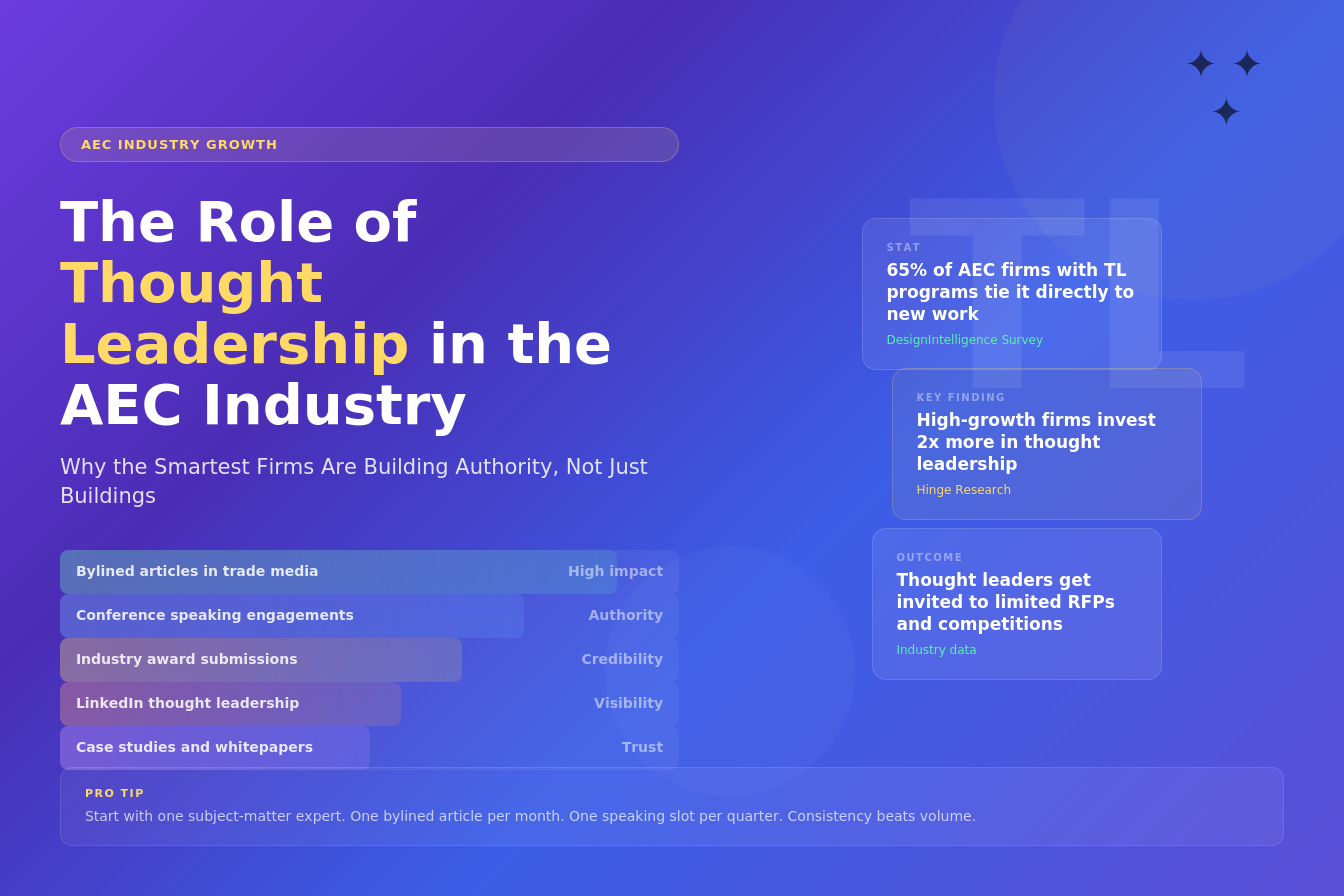
Research from Hinge Marketing has shown that high-growth professional services firms invest approximately twice as much in thought leadership as their average-growth peers. The connection between visibility and talent acquisition is real.
Differentiation Is Getting Harder
When every firm on a shortlist has similar qualifications, similar project experience, and similar references, what makes one stand out? Increasingly, the answer is the perception of expertise and industry authority. A DesignIntelligence survey found that more than 65% of AEC firms with thought leadership programs could draw a direct or indirect line between those programs and new work.
Thought leaders do not just land more projects. They land better projects, at better margins, with clients who already trust them.
The Five Channels of AEC Thought Leadership
1. Bylined Articles in Trade and Business Media
Publishing bylined articles in outlets like ENR, Building Design + Construction, Architectural Record, Construction Dive, and regional business journals is one of the most impactful thought leadership activities available.
These articles position your experts in front of the exact audience you want to reach: developers, owners, fellow industry professionals, and media. Unlike paid advertising, a bylined article carries editorial credibility. The publication reviewed and accepted your content because they believed it would provide value to their readers.
Topics that work well include trend analysis (such as the impact of new building codes on project delivery), data-driven insights (like regional construction spending patterns), and expert commentary on industry challenges (workforce development, supply chain disruption, or regulatory changes).
A construction PR agency can identify the right publications, develop story angles aligned with editorial calendars, and ghostwrite articles that reflect your leadership’s voice and expertise.
2. Speaking Engagements and Conference Appearances
Industry events like Greenbuild, the AIA Conference on Architecture, World of Concrete, CONEXPO, AGC conventions, and regional association meetings offer platforms where your experts can present to rooms full of potential clients and partners.
Speaking is one of the highest-trust thought leadership activities because it requires real expertise. You cannot fake a 45-minute presentation on BIM integration or sustainable construction practices. The audience knows whether you know your material.
Beyond the event itself, speaking engagements generate content. Presentations can be repurposed into articles, social posts, videos, and webinars that extend the reach of your ideas far beyond the conference room.
3. Industry Award Submissions
Winning recognized awards from organizations like AGC, ABC, DBIA, ENR, and state-level builder associations is a form of thought leadership because it subjects your work to third-party evaluation and endorsement.
The key is being strategic about which awards you pursue. Not all programs carry the same weight. Focus on those that are respected by your target clients and that allow you to showcase the specific capabilities you want to be known for.
The PR strategy for winning contracts is directly supported by award wins. Every award is a proof point you can include in proposals, presentations, and media pitches.
4. LinkedIn and Digital Presence
LinkedIn has become the primary professional networking platform for the AEC industry. Decision-makers, project owners, and industry peers spend significant time on the platform. Your leadership team’s presence there is no longer optional.
Effective LinkedIn thought leadership includes regular posts sharing industry insights (not company announcements), commenting thoughtfully on trending industry topics, publishing long-form articles on the platform, and engaging with content from industry peers and publications.
The goal is not follower count. It is demonstrating consistent expertise and engagement in the conversations that matter to your market.
5. Case Studies, Whitepapers, and Research
Detailed project case studies that go beyond “we built this” to explore the challenges, innovations, and outcomes of your work are powerful thought leadership tools. They provide concrete evidence of your expertise in a format that potential clients can evaluate.
Whitepapers and original research reports take this further. A firm that publishes data-driven analysis on topics like construction cost trends, material sourcing strategies, or the ROI of green building certification establishes itself as a knowledge leader, not just a service provider.
This type of content also supports SEO, driving organic traffic from industry professionals searching for exactly the information you have published.
How to Start a Thought Leadership Program
If your firm is not currently doing thought leadership, the prospect of starting can feel overwhelming. It does not need to be.
Identify Your Subject-Matter Experts
Who in your organization has deep expertise and opinions worth sharing? This could be your CEO, your chief estimator, your safety director, your head of preconstruction, or a project executive with decades of experience. Start with one or two people. You do not need a roster of 10 contributors.
Define Your Topics
What does your firm know better than most? Where do your experts disagree with industry conventional wisdom? What trends are you seeing on your projects that the broader market has not caught up to yet?
The best thought leadership topics are specific, timely, and grounded in real experience. “The future of construction” is too broad. “How prefabrication is reducing project timelines on healthcare facilities in the Southeast” is specific enough to attract the right audience.
Choose Your Channels
You do not need to be everywhere. Pick two or three channels that align with where your target audience already spends time. If your clients read ENR, focus on bylined articles there. If your market is regional, target local business journals and association events. If your recruiting is a priority, invest in LinkedIn.
Create a Consistent Cadence
Thought leadership works through consistency, not volume. One well-researched article per month, one speaking engagement per quarter, and regular LinkedIn posts from your key experts will produce meaningful results over six to twelve months.
The construction firms that start now will have a compounding advantage over competitors who keep putting it off.
Measure What Matters
Track inbound inquiries that reference your content. Monitor media mentions and citation frequency. Log RFP invitations that come from firms or individuals who engage with your published work. Track website traffic to your thought leadership content. Measure recruitment metrics tied to your public visibility.
These are the signals that connect thought leadership to business outcomes.
The Thought Leadership and PR Connection
Thought leadership and public relations are not separate strategies. They reinforce each other.
PR secures media placements that amplify your thought leadership content. Thought leadership provides the substance that makes your PR pitches compelling. Media coverage builds the credibility that makes your speaking proposals accepted. Speaking engagements generate content that feeds your PR program.
This is why the most effective AEC firms work with a PR partner who understands both disciplines. At AceIt Agency, our construction PR team integrates thought leadership development with media relations, ensuring your expertise reaches the audiences that matter most. We also help firms prepare for the moments when visibility matters most, through our crisis communications practice.
The Risk of Staying Silent
Here is the final point, and it is the most important one.
If your firm is not actively participating in industry conversations through thought leadership, you are not neutral. You are invisible. And in an industry where trust, reputation, and perceived expertise drive contract decisions, invisibility is a competitive disadvantage you cannot afford.
Your competitors are publishing. They are speaking. They are winning awards. They are building the public profiles that influence which firms get called first.
The question is not whether thought leadership works. The data confirms it does. The question is whether your firm will start building its authority now or wait until the gap is too wide to close.
Schedule Your Free Strategy Call
Related reading: