
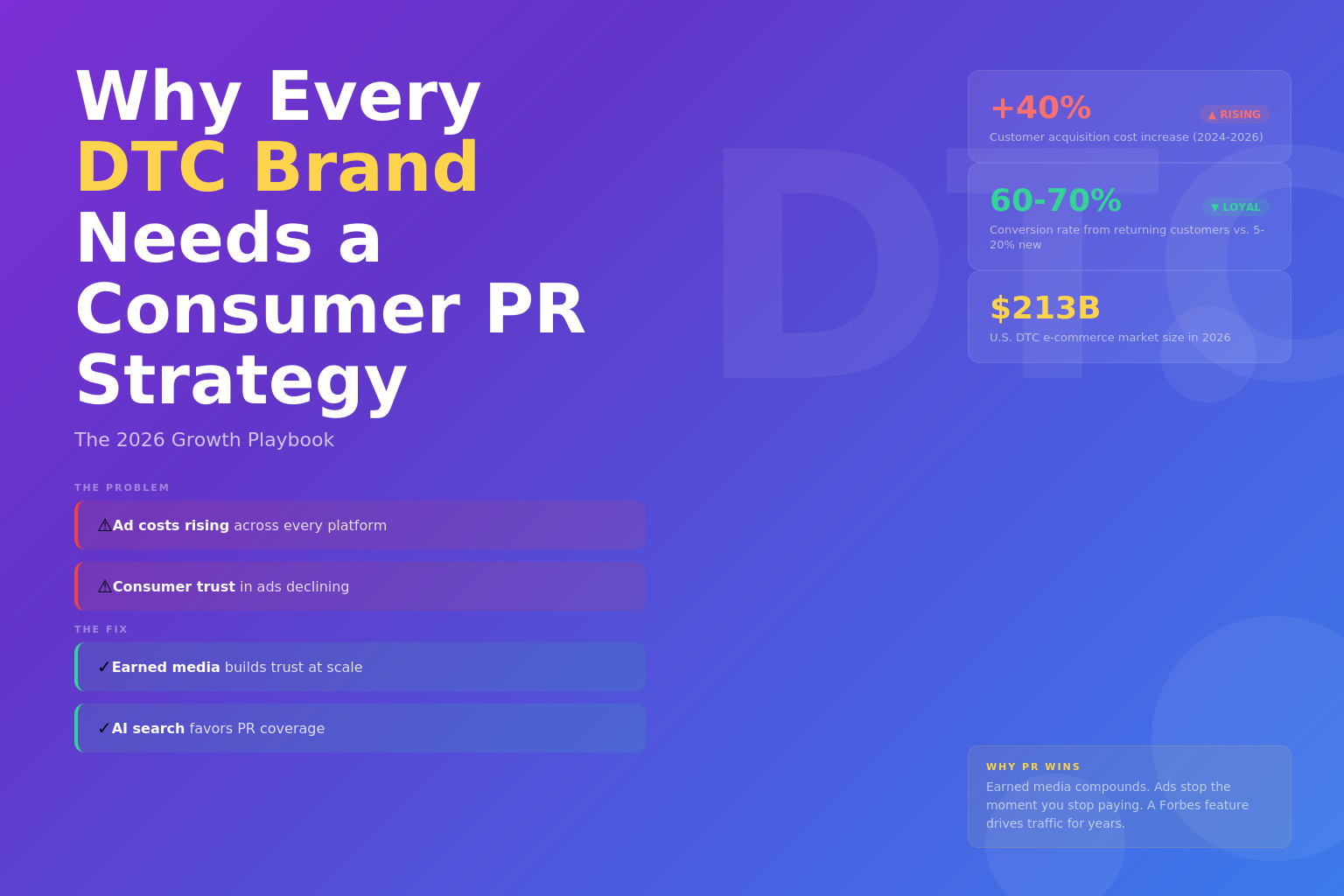
If you’re running a direct-to-consumer brand in 2026, you already know the math on paid acquisition has changed. Customer acquisition costs are up significantly across every major platform. Meta ad costs have climbed year over year. TikTok is getting more competitive by the quarter. And consumers, especially younger ones, are getting better at tuning out anything that looks, feels, or smells like an ad.
So where does that leave DTC brands that still need to grow?
It leaves them with consumer PR. And not as a nice-to-have. As a core growth channel that directly impacts how consumers discover, trust, and buy from your brand.
The DTC Acquisition Problem
Let’s talk about the elephant in the room. The “growth at all costs” era of DTC is over. The playbook that built brands like Warby Parker, Casper, and Dollar Shave Club in the early 2010s, pour money into digital ads, acquire customers at any cost, figure out profitability later, doesn’t work anymore.
Ad platforms are more expensive. Privacy changes have made targeting less precise. And consumers are exhausted by the sheer volume of sponsored content in their feeds. The result? DTC brands are spending more to acquire each customer while getting less return on every dollar spent.
This is exactly the environment where consumer PR becomes not just valuable, but essential.
What Consumer PR Does for DTC Brands That Ads Can’t
It builds trust before the first click. When a potential customer sees your DTC brand mentioned in Forbes, reviewed by a trusted creator, or featured in a “best of” roundup on Wirecutter, they arrive at your website with a fundamentally different mindset than someone who clicked a Facebook ad. They’ve already been pre-sold by a source they trust. That translates to higher conversion rates, lower bounce rates, and fewer abandoned carts.
It creates compounding value. A media placement in a respected outlet doesn’t disappear when your budget runs out. It stays indexed in Google. It gets cited by AI search engines. It gets linked to by other publications. A single well-placed product review can drive traffic for years. Compare that to a paid ad that stops working the second you turn it off.
It reduces your blended CAC. When earned media brings in customers organically, your cost per acquisition drops across the board, even on your paid channels. That’s because PR-driven awareness makes your ads more effective. A consumer who’s already seen your brand mentioned by a trusted third party is more likely to convert when they see your ad later.
It feeds AI-powered discovery. This one is huge, and most DTC brands are sleeping on it. AI search tools like ChatGPT, Perplexity, and Google’s AI Overview pull their product recommendations primarily from authoritative, third-party sources. That means earned media. Brands with a strong media footprint are showing up when consumers ask AI for product recommendations. Brands without one are invisible. We covered this shift in detail in our piece on how AI search is changing consumer PR.
What a Consumer PR Strategy Looks Like for DTC
Working with a consumer PR agency isn’t about sending out a press release and hoping for the best. For DTC brands, a strong PR strategy touches every stage of the customer journey.
Brand positioning and narrative. Before pitching anyone, your brand story needs to be clear. Why do you exist? What’s your point of view? What makes you different from the 50 other brands in your category? Great PR starts with a story that journalists and consumers actually want to share.
Targeted media outreach. Getting your products into the right publications matters more than getting into every publication. A feature in a niche outlet your target customer reads daily will drive more revenue than a mention in a massive outlet nobody in your audience cares about. The best consumer PR strategies are built on understanding exactly where your buyer spends their attention.
Influencer and creator partnerships. For DTC brands, influencer marketing isn’t separate from PR. It’s an integrated part of how your brand builds credibility. Working with creators who genuinely use and believe in your product creates the kind of authentic endorsement that consumers respond to. The key is choosing partners based on audience alignment, not follower counts.
Product launch campaigns. Launching a new product is one of the highest-leverage moments for PR investment. A coordinated campaign that combines media coverage, creator content, and owned channel amplification can create the kind of first-week momentum that sets the trajectory for your entire product lifecycle. We wrote a full guide on how to execute product launch PR for consumer brands.
Ongoing brand building. PR isn’t a one-time event. The most successful DTC brands maintain a consistent presence in media through seasonal campaigns, trend-driven pitching, founder thought leadership, and steady product reviews. This sustained visibility is what separates brands that spike and fade from brands that build lasting consumer loyalty.
Why 2026 Is the Year to Start
Three converging forces make 2026 the most important year for DTC brands to invest in consumer PR:
First, ad costs are only going up. Every platform is getting more expensive, and the trend isn’t reversing. Brands that build organic discovery channels now will be better insulated from platform volatility.
Second, AI search is rewarding earned media. As we covered in our deep dive on AI and consumer PR, generative search engines heavily favor third-party media when generating product recommendations. The brands building their earned media footprint now are the ones that will dominate AI-powered discovery for years to come.
Third, consumer trust in advertising is declining while trust in editorial content holds strong. In a market where consumers are more skeptical than ever, the brands that earn trust through credible, third-party validation will outperform the ones that try to buy it through ads.
How AceIt Agency Works with DTC Brands
At AceIt Agency, our consumer PR practice is built for exactly this kind of work. We help DTC brands build the kind of media presence that drives real business results, not just vanity metrics.
Whether it’s launching a new product, building a sustained media presence, or creating an integrated PR and influencer strategy, our team brings the relationships, the strategy, and the execution to make it happen.
If you’re still weighing whether your brand needs consumer PR or a different kind of public relations, our breakdown of consumer PR vs. B2B PR can help clarify which approach fits your business. And if you want to understand how media coverage directly impacts online sales, read our piece on how consumer brands use earned media to drive e-commerce results.